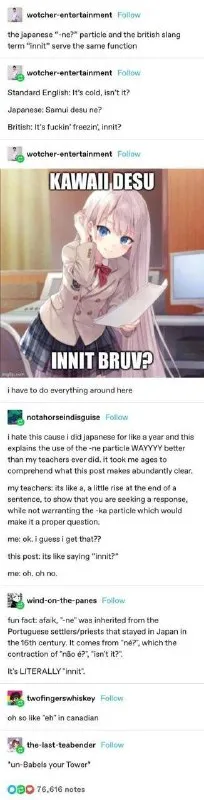
Kawaii Desu Innit Bruv
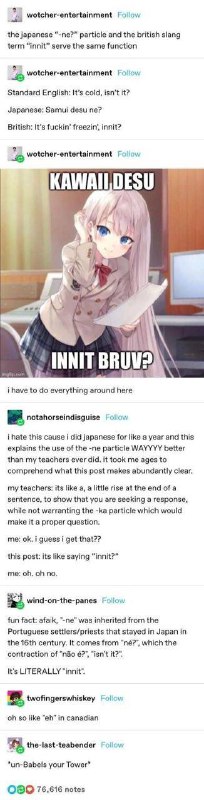
the Japanese “ne?” particle and the british slang term “innit” serve the same function Standard English: Is this cold, isn’t it? Japanese: Samui desu ne? British: It’s fuckin’ freezin’, innit? KAWAII DESU INNIT BRUV? i have to do everything around here i hate this cause i did japanese for like a year and this explains the use of the -ne particle WAYYY better than my teachers ever did, it took me ages to comprehend what this post makes abundantly clear. my teachers: its like a, a little rise at the end of a sentence, to show that you are seeking a response, while not warranting the kinda particle which would make it a proper question? me: ok i guess i get that?? this post: its like saying “innit?” me: oh. oh no. fun fact: afaik, “ne” was inherited from Portuguese settlers/priests that stayed in Japan in the 16th century. It comes from “né”, which the contraction of “não é?”, “isn’t it?” It’s LITERALLY “innit”. oh so like “eh” in canadian ‘un-Bables Tower’
Текст сравнивает японскую частицу «ne?» с британским разговорным «innit», показывая, что оба выражают ожидание подтверждения вроде «не так ли?». В центре — аниме-девушка с подписями «KAWAII DESU» и «INNIT BRUV?». Шутка строится на неожиданно простом объяснении грамматики и абсурдном смешении японской и британской речи.
- @rzeczyzabawne / 6959 2023-03-02
- @rzeczyzabawne / 22380 2026-03-04
- Type
- image
- Size
- 204×800 · 46.2 KiB
- Mood
- absurd, educational
- Language
- en
- Added