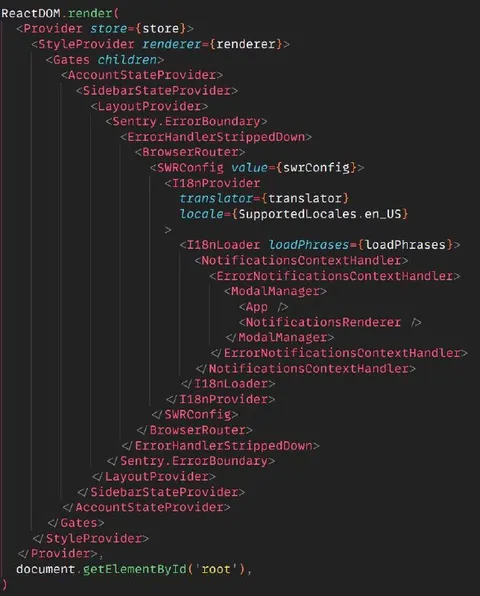
React App Provider Nesting
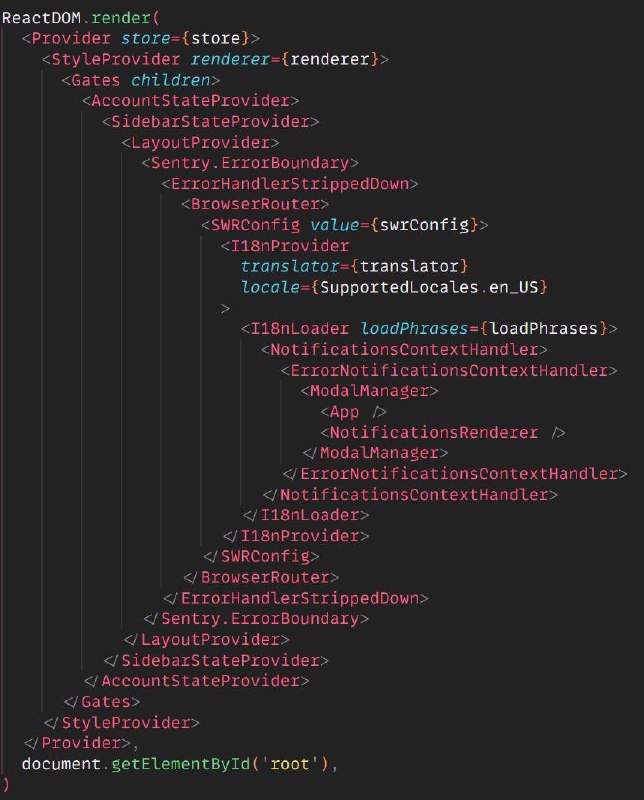
ReactDOM.render( <Provider store={store}> <StyleProvider renderer={renderer}> <Gates children> <AccountStateProvider> <SidebarStateProvider> <LayoutProvider> <Sentry.ErrorBoundary> <ErrorHandlerStrippedDown> <BrowserRouter> <SWConfig value={swConfig}> <I18nProvider translator={translator} locale={SupportedLocales.en_US} > <I18nLoader loadPhrases={loadPhrases}> <NotificationsContextHandler> <ErrorNotificationsContextHandler> <ModalManager> <App> <NotificationsRenderer /> </App> </ModalManager> </ErrorNotificationsContextHandler> </NotificationsContextHandler> </I18nLoader> </I18nProvider> </SWConfig> </BrowserRouter> </ErrorHandlerStrippedDown> </Sentry.ErrorBoundary> </LayoutProvider> </SidebarStateProvider> </AccountStateProvider> </Gates> </StyleProvider> </Provider> ) document.getElementById('root'),
A screenshot shows an extremely deeply nested React component tree, with providers, error boundaries, routing, internationalization, notifications, and a modal manager wrapped around the app. The joke is that a simple React application has accumulated an absurd number of architectural wrappers and context providers, making the code look overwhelming and comically overengineered. It is typically shared as a reaction to excessive frontend complexity or provider nesting. EN: A screenshot shows an extremely deeply nested React component tree, with providers, error boundaries, routing, internationalization, notifications, and a modal manager wrapped around the app. The joke is that a simple React application has accumulated an absurd number of architectural wrappers and context providers, making the code look overwhelming and comically overengineered. It is typically shared as a reaction to excessive frontend complexity or provider nesting.
- @gentoomemes / 3687 2023-04-07
- Type
- image
- Size
- 644×800 · 85.7 KiB
- Mood
- sarcastic, overwhelmed
- Language
- en
- Added