IDA Decompiled Code Explained
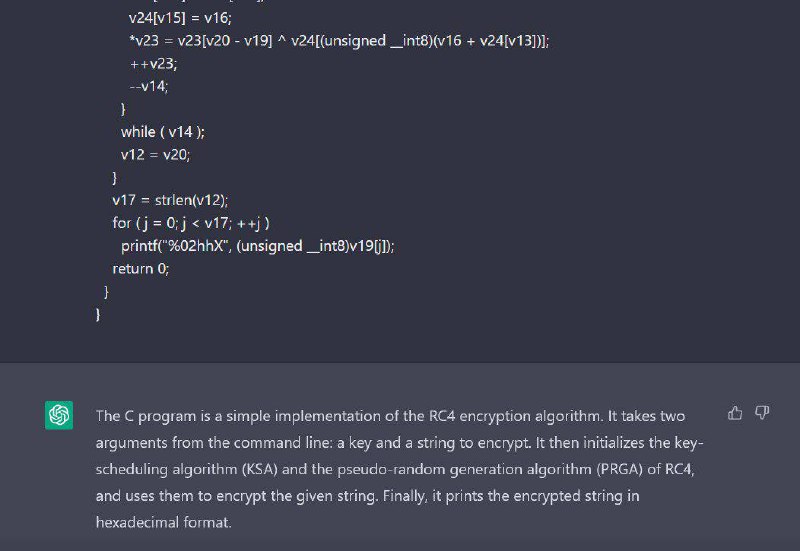
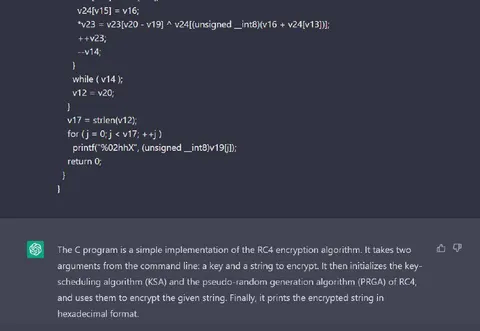
v24[v15] = v16; *v23 = v23[v20 - v19] ^ v24[(unsigned __int8)(v16 + v24[v13])]; ++v23; --v14; } while (v14); v12 = v20; } v17 = strlen(v12); for (j = 0; j < v17; ++j) printf("%02X", (unsigned __int8)v19[j]); return 0; } } The C program is a simple implementation of the RC4 encryption algorithm. It takes two arguments from the command line: a key and a string to encrypt. It then initializes the key-scheduling algorithm (KSA) and the pseudo-random generation algorithm (PRGA) of RC4, and uses them to encrypt the given string. Finally, it prints the encrypted string in hexadecimal format.
A screenshot shows decompiled C code in a dark-themed interface, followed by an AI-generated explanation identifying it as a simple RC4 encryption implementation. The joke is that reverse-engineering work becomes much easier when a programmer can paste confusing IDA output into an AI chatbot and receive a readable summary. It is used as a reaction to AI automating or simplifying difficult programming and cybersecurity tasks.
decompiled C code / декомпилированный код на Ccode editor window / окно редактора кодаAI chatbot response / ответ ИИ-чатботаOpenAI logo / логотип OpenAIdark user interface / тёмный интерфейсprogramming text / текст программыencryption algorithm / алгоритм шифрованияhexadecimal output / шестнадцатеричный выводthumbs-up icon / значок большого пальца вверхthumbs-down icon / значок большого пальца вниз
- @gentoomemes / 1442 2022-12-02
- Type
- image
- Size
- 800×551 · 47.7 KiB
- Mood
- саркастичный, удивлённый
- Language
- en
- Added