I Love Functional Programming
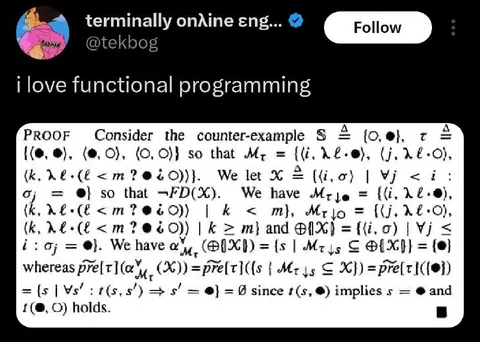
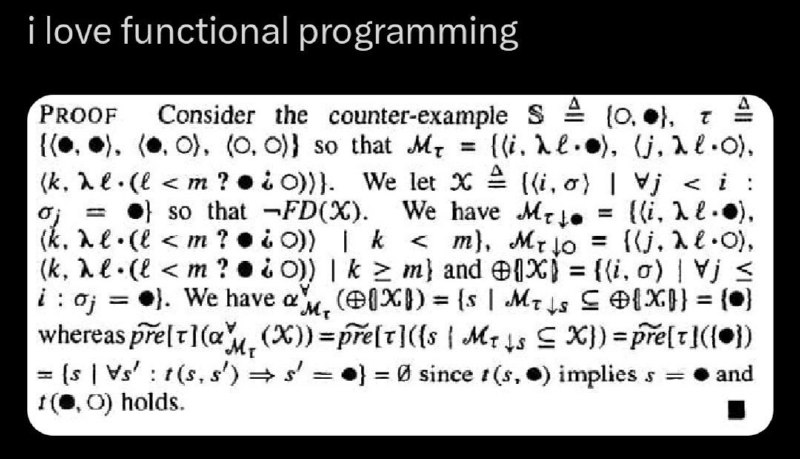
i love functional programming PROOF Consider the counter-example S ≜ {O, ●}, τ ≜ {[(●, ●), (●, O), (O, O)]} so that Mτ = {(i, λℓ·●), (j, λℓ·O), (k, λℓ·(ℓ < m ? ● : O))}. We let X ≜ {(i, σ) | ∀j < i : σj = ●} so that ¬FD(X). We have Mτ↓● = {((i, λℓ·●), (k, λℓ·(ℓ < m ? ● : O)) | k < m), Mτ↓O = {((j, λℓ·O), (k, λℓ·(ℓ < m ? ● : O)) | k ≥ m] and ⊕∥X∥ = {(i, σ) | ∀j ≤ i : σj = ●}. We have αMτ(⊕∥X∥) = {s | Mτ↓s ⊆ ⊕∥X∥} = {●} whereas p̃re[τ](αMτ(X)) = p̃re[τ]({s | Mτ↓s ⊆ X}) = p̃re[τ]({●}) = {s | ∀s′ : t(s, s′) ⇒ s′ = ●} = ∅ since t(s, ●) implies s = ● and t(●, O) holds.
The meme shows the phrase “i love functional programming” above an intentionally dense mathematical proof filled with formal notation. The joke is that functional programming is presented as an incomprehensible proof, so it is used as a reaction to overly abstract code, type theory, or explanations that only programmers with very specific expertise can understand.
mathematical proof / математическое доказательствоdense formal notation / плотная формальная записьblack background / чёрный фонwhite rounded rectangle / белый скруглённый прямоугольникprinted serif text / печатный текст с засечкамиlogic symbols / логические символыblack square / чёрный квадратprogramming reference / отсылка к программированию
- @right_wing_dev_squads / 12737 2025-08-19
- Type
- image
- Size
- 800×459 · 77.7 KiB
- Mood
- absurd, sarcastic
- Language
- en
- Added