Printer Tracking Dots Explained
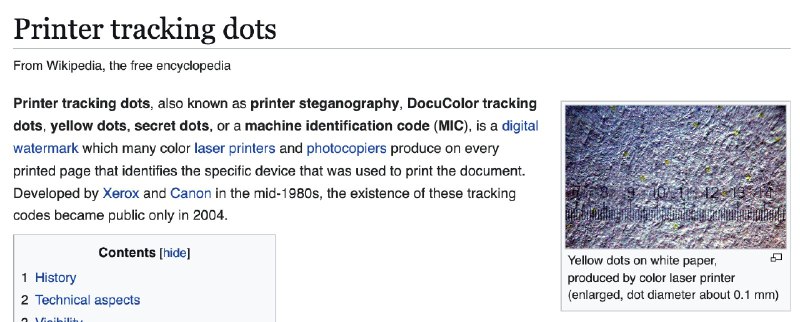
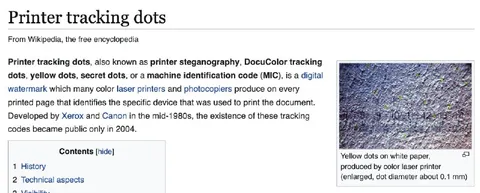
Printer tracking dots From Wikipedia, the free encyclopedia Printer tracking dots, also known as printer steganography, DocuColor tracking dots, yellow dots, secret dots, or a machine identification code (MIC), is a digital watermark which many color laser printers and photocopiers produce on every printed page that identifies the specific device that was used to print the document. Developed by Xerox and Canon in the mid-1980s, the existence of these tracking codes became public only in 2004. Contents [hide] 1 History 2 Technical aspects 3 Visibility Yellow dots on white paper, produced by color laser printer (enlarged, dot diameter about 0.1 mm)
A screenshot of a Wikipedia article about printer tracking dots, showing microscopic yellow dots produced by a color laser printer. The joke is that printers secretly add identifying marks to printed pages, which can theoretically help authorities trace a printer used in a crime; the uploader’s caption presents this real fact as an explanation for why printers need yellow ink. EN: A screenshot of a Wikipedia article about printer tracking dots, showing microscopic yellow dots produced by a color laser printer. The joke is that printers secretly add identifying marks to printed pages, which can theoretically help authorities trace a printer used in a crime; the uploader’s caption presents this real fact as an explanation for why printers need yellow ink.
- @eternalclassic / 63656 2025-01-17
- Type
- image
- Size
- 800×322 · 64.7 KiB
- Mood
- absurd, conspiratorial
- Language
- en
- Added