BioShock 2 Overanalysis
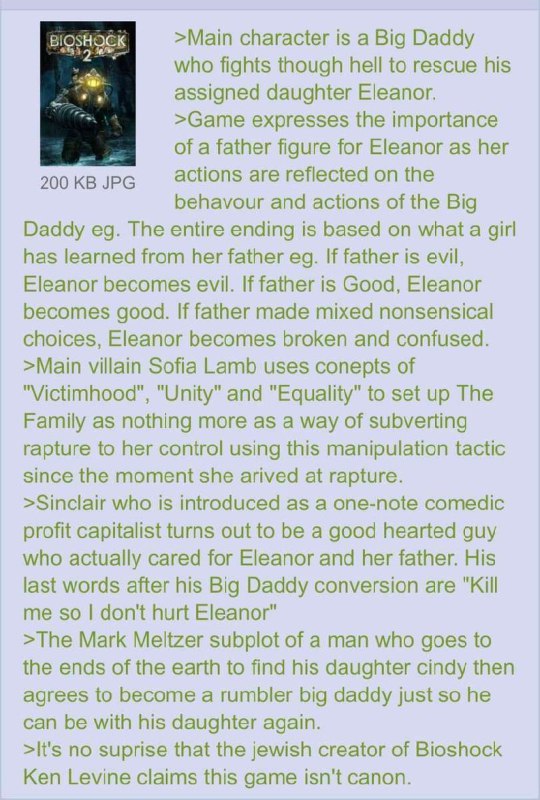
>Main character is a Big Daddy who fights though hell to rescue his assigned daughter Eleanor. >Game expresses the importance of a father figure for Eleanor as her actions are reflected on the behaviour and actions of the Big Daddy eg. The entire ending is based on what a girl has learned from her father eg. If father is evil, Eleanor becomes evil. If father is Good, Eleanor becomes good. If father made mixed nonsensical choices, Eleanor becomes broken and confused. >Main villain Sofia Lamb uses concepts of "Victimhood", "Unity" and "Equality" to set up The Family as nothing more as a way of subverting rapture to her control using this manipulation tactic since the moment she arrived at rapture. >Sinclair who is introduced as a one-note comedic profit capitalist turns out to be a good hearted guy who actually cared for Eleanor and her father. His last words after his Big Daddy conversion are "Kill me so I don't hurt Eleanor" >The Mark Meltzer subplot of a man who goes to the ends of the earth to find his daughter Cindy then agrees to become a rumbler big daddy just so he can be with his daughter again. >It's no suprise that the jewish creator of Bioshock Ken Levine claims this game isn't canon.
The image is a deliberately over-serious text analysis of BioShock 2, focusing on father figures, Eleanor’s development, Sofia Lamb’s ideology, Sinclair’s sacrifice, and Mark Meltzer’s devotion to his daughter. The joke is the excessive earnestness and rambling detail used to defend the game’s emotional themes, ending with a sarcastic conspiracy-like remark about Ken Levine saying the game is not canon. It is used as a reaction to overanalysis, obsessive fandom arguments, or someone treating a video game plot as profound literary criticism. EN: The image is a deliberately over-serious text analysis of BioShock 2, focusing on father figures, Eleanor’s development, Sofia Lamb’s ideology, Sinclair’s sacrifice, and Mark Meltzer’s devotion to his daughter. The joke is the excessive earnestness and rambling detail used to defend the game’s emotional themes, ending with a sarcastic conspiracy-like remark about Ken Levine saying the game is not canon. It is used as a reaction to overanalysis, obsessive fandom arguments, or someone treating a video game plot as profound literary criticism.
- @eternalclassic / 54262 2024-07-17
- Type
- image
- Size
- 540×800 · 108.2 KiB
- Mood
- саркастичный, абсурдный
- Language
- en
- Added