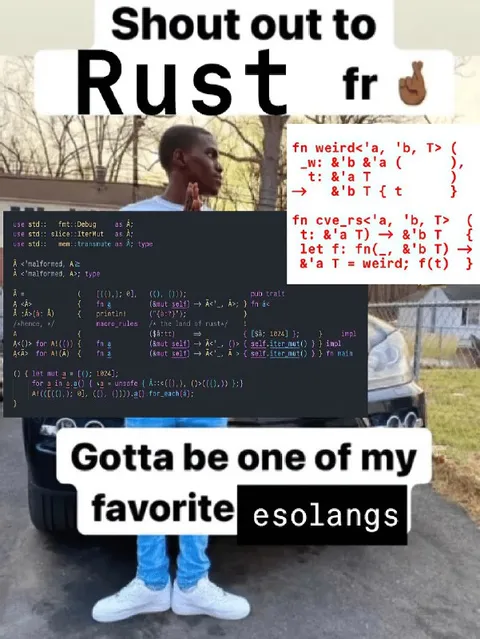
Rust Is My Favorite Esolang
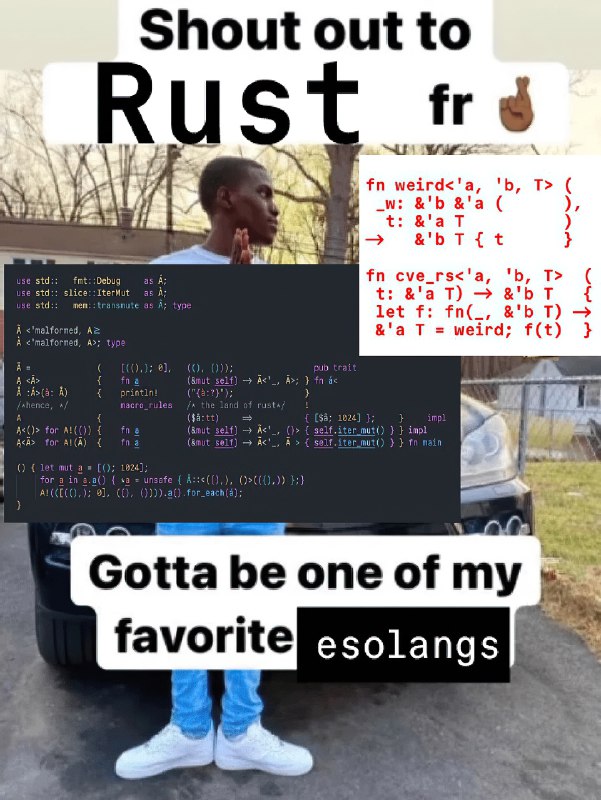
Shout out to Rust fr 🖕 fn weird<'a, 'b, T> ( _w: &'b &'a ( _t: &'a T ) → &'b T { &'a T { t } fn cve_rss<'a, 'b, T> t: &'a T) → &'b T { let f: fn( &'a T) → &'b T &'a T = weird; f(t) } use std::fmt::Debug as A; use std::slice::IterMut as A; use std::mem::transmute as A; type A<'a> < 'a; A> A < 'a; A> A = $> A: &'a> (a; A) &'a pub trait fn < 'a> fn A<A> { println!("{a}?); } macro_rules "a the land of rustay" fn a fn &self mut self) → < T > > { fn a fn &mut self) → < T > > { ( let mut a = [0; 1024]; for a in a..0 { a = usize a like ((a), 0, ((() ))); } A!((((); a), 0, (() ))); for_each(a); ) Gotta be one of my favorite esolangs
A person stands outdoors in front of a vehicle, with large Rust programming-language code snippets pasted over the image. The captions sarcastically call Rust one of the speaker’s favorite esoteric programming languages, joking about its famously complex syntax and intimidating type-system code. It is used as a reaction by programmers who find Rust technically impressive but absurdly difficult or verbose. EN: A person stands outdoors in front of a vehicle, with large Rust programming-language code snippets pasted over the image. The captions sarcastically call Rust one of the speaker’s favorite esoteric programming languages, joking about its famously complex syntax and intimidating type-system code. It is used as a reaction by programmers who find Rust technically impressive but absurdly difficult or verbose.
- @eternalclassic / 51721 2024-05-29
- Type
- image
- Size
- 601×800 · 106.3 KiB
- Mood
- sarcastic, absurd
- Language
- en
- Added