English Swearing Versus Slavic Languages
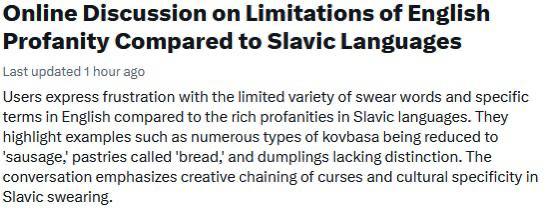
Online Discussion on Limitations of English Profanity Compared to Slavic Languages Last updated 1 hour ago Users express frustration with the limited variety of swear words and specific terms in English compared to the rich profanities in Slavic languages. They highlight examples such as numerous types of kovbasa being reduced to 'sausage,' pastries called 'bread,' and dumplings lacking distinction. The conversation emphasizes creative chaining of curses and cultural specificity in Slavic swearing.
A mock online discussion complains that English has fewer precise swear words and food terms than Slavic languages. The joke exaggerates cultural and linguistic differences, especially the idea that many kinds of kovbasa, pastries, and dumplings are flattened into generic English words. It can be shared as a reaction about Slavic languages being more expressive, specific, or creatively profane.
- @rzeczyzabawne / 22612 2026-04-16
- Type
- image
- Size
- 550×212 · 30.3 KiB
- Mood
- sarcastic
- Language
- en
- Added