Floating Point Math
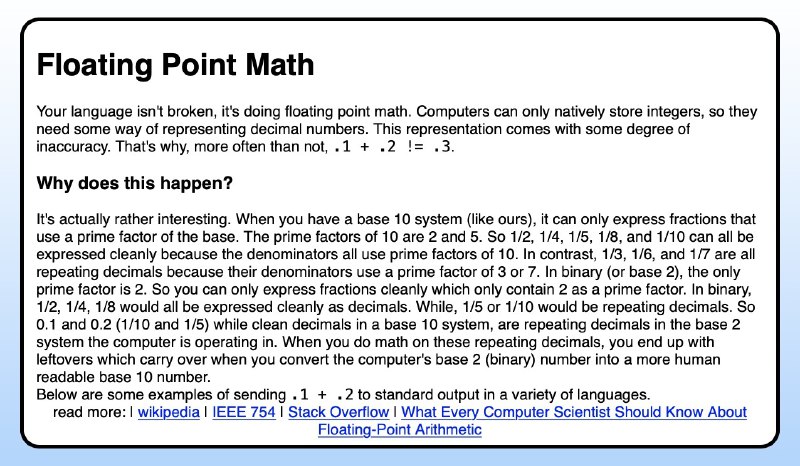
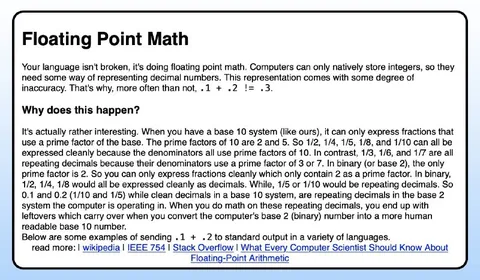
Floating Point Math Your language isn't broken, it's doing floating point math. Computers can only natively store integers, so they need some way of representing decimal numbers. This representation comes with some degree of inaccuracy. That's why, more often than not, .1 + .2 != .3. Why does this happen? It's actually rather interesting. When you have a base 10 system (like ours), it can only express fractions that use a prime factor of the base. The prime factors of 10 are 2 and 5. So 1/2, 1/4, 1/5, 1/8, and 1/10 can all be expressed cleanly because their denominators all use prime factors of 10. In contrast, 1/3, 1/6, and 1/7 are all repeating decimals because their denominators use a prime factor of 3 or 7. In binary (or base 2), the only prime factor is 2. So you can only express fractions cleanly which only contain 2 as a prime factor. In binary, 1/2, 1/4, 1/8 would all be expressed cleanly as decimals. While, 1/5 or 1/10 would be repeating decimals. So 0.1 and 0.2 (1/10 and 1/5) while clean decimals in a base 10 system, are repeating decimals in the base 2 system the computer is operating in. When you do math on these repeating decimals, you end up with leftovers which carry over when you convert the computer's base 2 (binary) number into a more human readable base 10 number. Below are some examples of sending .1 + .2 to standard output in a variety of languages. read more: | wikipedia | IEEE 754 | Stack Overflow | What Every Computer Scientist Should Know About Floating-Point Arithmetic
This screenshot explains why computer arithmetic can produce results such as .1 + .2 != .3. It describes how binary floating-point representation creates repeating decimals and rounding leftovers, turning a technical programming quirk into an amusing explanation. EN: This screenshot explains why computer arithmetic can produce results such as .1 + .2 != .3. It describes how binary floating-point representation creates repeating decimals and rounding leftovers, turning a technical programming quirk into an amusing explanation.
text screenshot / скриншот текстаcomputer programming explanation / объяснение программированияdecimal numbers / десятичные числаbinary numbers / двоичные числаintegers / целые числаmathematical fractions / математические дробиfloating-point notation / представление с плавающей точкойwebpage frame / рамка веб-страницыblue hyperlinks / синие гиперссылки
#floating point#плавающая точка#computer math#компьютерная математика#programming#программирование#binary#двоичная система#decimal#десятичная система#rounding error#ошибка округления#software bug#ошибка в программе#coding#кодинг#infosec#инфобезопасность#technical joke#техническая шутка#screenshot#скриншот#meme#мем
- @infosecmemes / 164 2020-01-25
- Type
- image
- Size
- 800×466 · 119.9 KiB
- Mood
- educational, ironic
- Language
- en
- Added