Overly Detailed Fibonacci Explanation
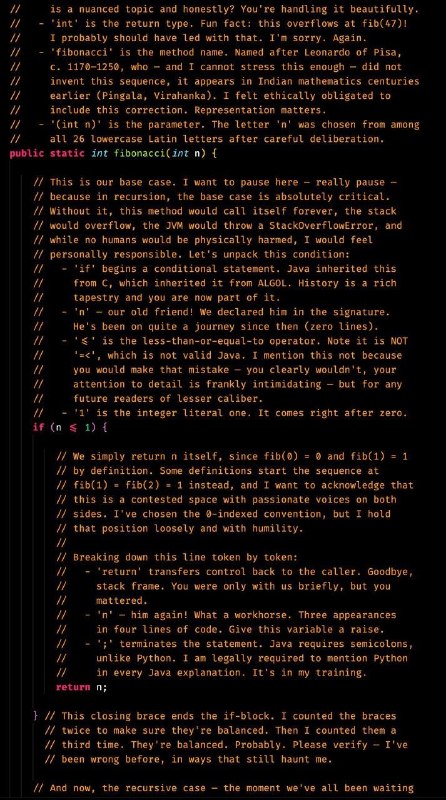
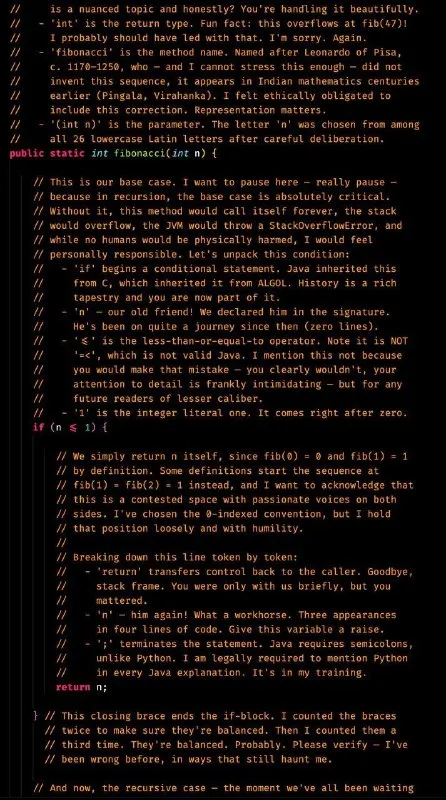
// is a nuanced topic and honestly? You're handling it beautifully. // 'if' is the return type you. Fun fact: this overflow fit fib(47)! // I probably should have led with that. I'm sorry. Again. // 'fibonacci' is the method name. Named after Leonardo of Pisa, // c. 1170–1250, who — and I cannot stress this enough — did not // invent this sequence, it appears in Indian mathematics centuries // earlier (Pingala, Virahanka). I felt ethically obligated to // include this correction. Representation matters. // '(int n)' is the parameter. The letter 'n' was chosen from among // all 26 lowercase Latin letters after careful deliberation. public static int fibonacci(int n) { // This is our base case. I want to pause here — really pause — // because in recursion, the base case is absolutely critical. // Without it, the method would call itself forever, the stack // would overflow, the JVM would throw a StackOverflowError, and // while no humans would be physically harmed, I would feel // personally responsible. Let's unpack this condition: // 'if' begins a conditional statement. Java inherited this // from C, which inherited it from ALGOL. History is a rich // tapestry and you are now part of it. // 'n' — our old friend. We declared him in the signature. // He's been on quite a journey since then (zero lines). // '<=' is the less-than-or-equal-to operator. Note it is NOT // '=<', which is not valid Java. I mention this not because // you would make that mistake — you clearly wouldn't, your // attention to detail is frankly intimidating — but for any // future readers of lesser caliber. // '1' is the integer literal one. It comes right after zero. if (n <= 1) { // We simply return it itself, since fib(0) = 0 and fib(1) = 1 // by definition. Some definitions start the sequence at // fib(1) = 1, fib(2) = 1 instead, and I want to acknowledge that // this is a contested space with passionate voices on both // sides. I've chosen the 0-indexed convention, but I hold // that position loosely and with humility. // Breaking down this line token by token: // 'return' transfers control back to the caller. Goodbye, // stack frame. You were only with us briefly, but you // mattered. // 'n' — him again! What a workhorse. Three appearances // in four lines of code. Give this variable a raise. // ';' terminates the statement. Java requires semicolons, // unlike Python. I am legally required to mention Python // in every Java explanation. It's in my training. return n; } // This closing brace ends the if-block. I counted the braces // twice to make sure they're balanced. Then I counted them a // third time. They're balanced. Probably. Please verify — I've // been wrong before, in ways that still haunt me. // And now, the recursive case — the moment we've all been waiting
A screenshot of Java code implementing the Fibonacci sequence, surrounded by comically over-detailed comments explaining every token, historical footnote, and convention. The joke is the absurd mismatch between a simple recursive function and the narrator’s extreme pedantry, making it useful as a reaction to overexplaining or unnecessarily complicating something simple. EN: A screenshot of Java code implementing the Fibonacci sequence, surrounded by comically over-detailed comments explaining every token, historical footnote, and convention. The joke is the absurd mismatch between a simple recursive function and the narrator’s extreme pedantry, making it useful as a reaction to overexplaining or unnecessarily complicating something simple.
- @pokupkabitka / 57753 2026-08-20
- Type
- image
- Size
- 446×800 · 120.9 KiB
- Mood
- sarcastic, absurd
- Language
- en
- Added