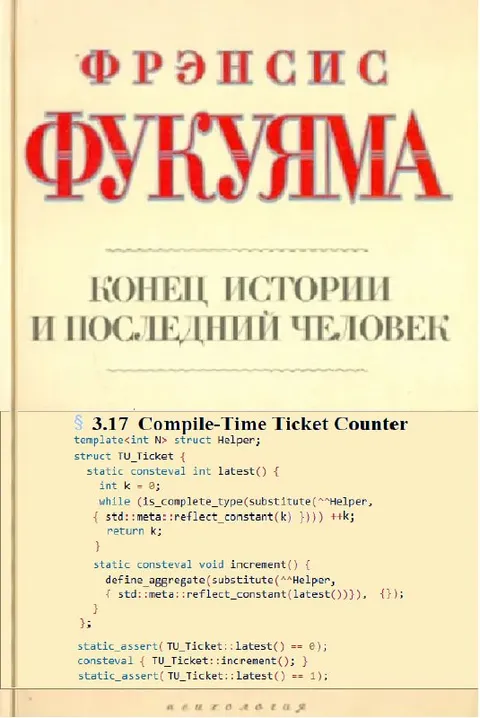
Фрэнсис Фукуяма и последний человек
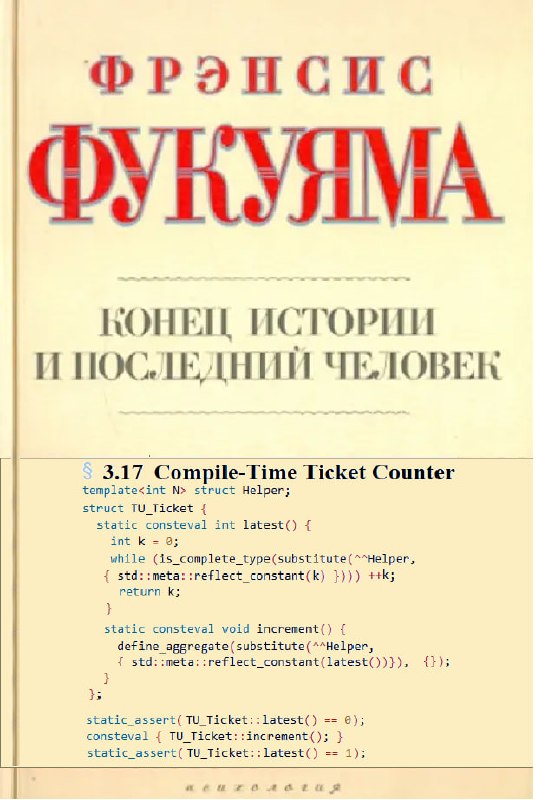
ФРЭНСИС ФУКУЯМА КОНЕЦ ИСТОРИИ И ПОСЛЕДНИЙ ЧЕЛОВЕК § 3.17 Compile-Time Ticket Counter template<int N> struct Helper; struct TU_Ticket { static consteval int latest() { int k = 0; while (is_complete_type(substitute(^Helper, { std::meta::reflect_constant(k) })) ^k; return k; } static consteval void increment() { define_aggregate(substitute(^Helper, { std::meta::reflect_constant(latest()) }), {}); } }; static_assert(TU_Ticket::latest() == 0); consteval { TU_Ticket::increment(); } static_assert(TU_Ticket::latest() == 1);
На изображении обложка книги Фрэнсиса Фукуямы «Конец истории и последний человек», поверх которой размещён фрагмент сложного шаблонного кода C++. Шутка в том, что философский «конец истории» сопоставляется с последним элементом compile-time-счётчика: после инкремента последний билет становится равен единице. Такой мем отправляют как абсурдную реакцию на чрезмерно сложный C++ и шутки о метапрограммировании. EN: The image shows the cover of Francis Fukuyama’s book The End of History and the Last Man, overlaid with a fragment of complex C++ template code. The joke compares the philosophical “end of history” with the last element of a compile-time counter: after incrementing, the latest ticket becomes one. This meme is shared as an absurd reaction to overly complicated C++ and metaprogramming jokes.
- @ithueti / 18351 2026-06-15
- Type
- image
- Size
- 535×800 · 78.8 KiB
- Mood
- абсурдный, саркастичный
- Language
- ru
- Added