RFC 1149: интернет через голубей
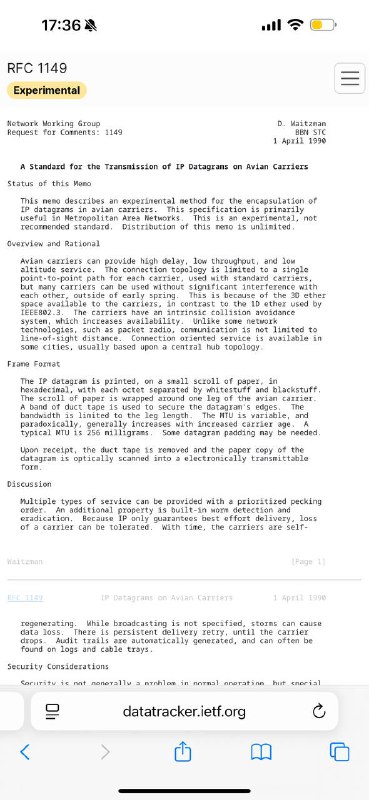
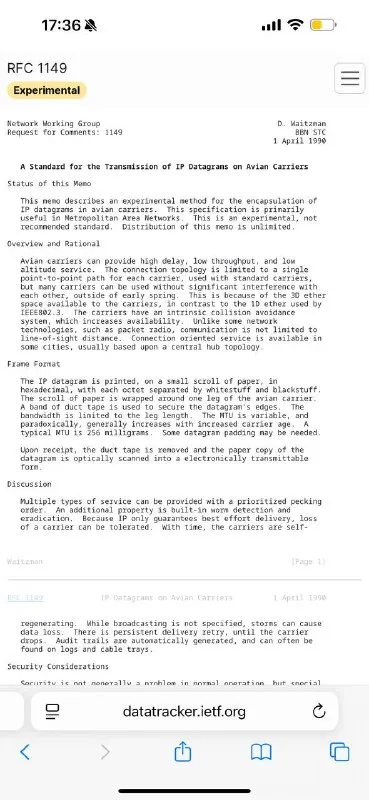
RFC 1149 Experimental Network Working Group D. Waitzman Request for Comments: 1149 BBN STC 1 April 1990 A Standard for the Transmission of IP Datagrams on Avian Carriers Status of this Memo This memo describes an experimental protocol for the encapsulation of IP datagrams in avian carriers. This specification is primarily for useful in Internet Area Networks. This is an experimental, not recommended standard. Distribution of this memo is unlimited. Overview and Rational Avian carriers can provide high delay, low throughput, and low altitude service. The connection topology is limited to a single point-to-point path for each carrier, used with standard carriers, but many carriers can be used without significant interference with each other, outside of escaping spring. This is because of the 30 ether space available to the carriers, in contrast to the 10 ether used by IEEE802.3. The carriers have an intrinsic low avoidance system, with increased availability. Unlike some network technologies, such as packet radio, communication is not limited to the one-sight distance. Connection oriented service is available in some cities, usually based upon a central hub topology. Frame Format The IP datagram is printed on a small scroll of paper, in hexadecimal, with each octet separated by whitespace and blackstuff. The scroll of paper is wrapped around the leg of the avian carrier. A band of duct tape is used to secure the datagram's edges. The bandwidth is limited to the leg length. The MTU is variable, and paradoxically, generally increases with increased carrier age. A typical MTU is 256 milligrams. Some datagram padding may be needed. Upon receipt, the duct tape is removed and the paper copy of the datagram is optically scanned into a electronically transmittable form. Discussion Multiple types of service can be provided with a prioritized pecking order. An additional property is built-in worm detection and eradication. Because IP only guarantees best effort delivery, loss of carrier can be tolerated. With time, the carriers are self- regenerating. While broadcasting is not specified, storms can cause data loss. There is persistent delivery retry, until the carrier drops. Audit trails are automatically generated, and can be found on logs and cable trays.
На изображении показана веб-страница RFC 1149 — шуточного экспериментального стандарта передачи IP-дейтаграмм с помощью почтовых голубей. Текст пародирует технический документ, описывая задержки, низкую пропускную способность, бумажные свитки и клейкую ленту как сетевой протокол. Шутка отсылает к реальному RFC 1149 от 1 апреля 1990 года и используется как абсурдный ответ на жалобы на отсутствие связи или интернета. EN: The image shows a webpage for RFC 1149, a humorous experimental standard for transmitting IP datagrams using carrier pigeons. The text parodies a technical document by describing delays, low throughput, paper scrolls, and duct tape as network protocol features. The joke references the real RFC 1149 published on April 1, 1990, and is used as an absurd response to complaints about having no phone or internet connection.
- @ithueti / 17804 2026-03-13
- Type
- image
- Size
- 369×800 · 69.2 KiB
- Mood
- абсурдный, саркастичный
- Language
- en
- Added