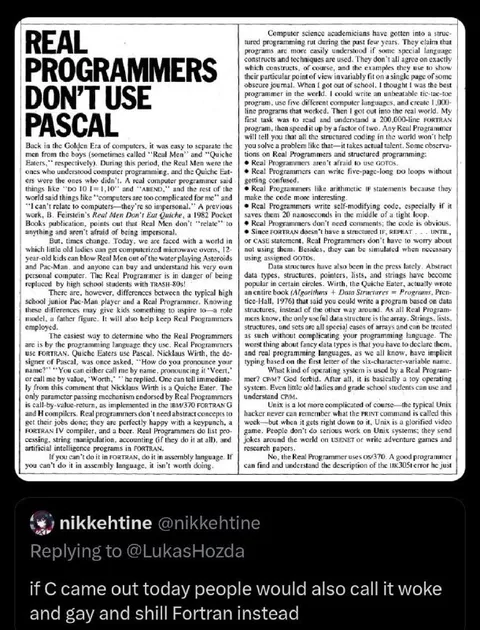
Real Programmers Use Fortran
REAL PROGRAMMERS DON'T USE PASCAL Back in the Golden Era of computers, it was easy to separate the men from the boys (sometimes called "Real Men" and "Quiche Eaters," respectively). During this period, the Real Men were the ones who understood computer programming, and the Quiche Eaters were the ones who didn't. A real computer programmer said things like "DO 10 I=1,10" and "ABEND," and the rest of the world said things like "cutesy"-computer stuff and complained for me "I can't relate to computers—they're so impersonal." A previous work, B. Feinstein's Real Men Don't Eat Quiche, a 1982 Pocket Books publication, points out that Real Men don't "relate" to anything and aren't afraid of being impersonal. But, times change. Today, we are faced with a world in which little old ladies can get computerized microwave ovens, 12-year-old kids can blow Real Men out of the water playing Asteroids and Pac-Man, and anyone can understand this very own person computer. The Real Programmer is in danger of being replaced by high school students with TRASH-80s! There are, however, differences between the typical high school junior Pac-Man player and a Real Programmer. Knowing these differences may give kids something to aspire to—a role model, a father figure. It will also help Real Programmers employed. The easiest way to determine who the Real Programmers are is by the programming language they use. Real Programmers use FORTRAN. Quiche Eaters use Pascal. Nicklaus Wirth, the designer of Pascal, was once asked, "How do you pronounce your language?" "You can either call me name, pronouncing it 'Vecat,' or call me by value, 'Wirth,'" he replied. One can tell immediately from this comment that Nicklaus Wirth is a Quiche Eater. The only programmer using mechanisms endorsed by Real Programmers is call-by-value-return, as implemented in the IBM/370 FORTAN G and H compilers. Real programmers don't need abstract concepts to get their jobs done; they prefer letting reality with a keypunch, a FORTRAN IV compiler, and a beer. Real programmers do list processing, string manipulation, accounting if they do it at all, and artificial intelligence programs in FORTRAN. If you can't do it in FORTRAN, do it in assembly language. If you can't do it in assembly language, it isn't worth doing. Computer science academicians have gotten into a structured programming rut during the past few years. They claim that programs are more easily understood if some special language constructs and techniques are used. They don't all agree on exactly which constructs, of course, and the examples they use to show their particular point of view invariably differ in a single page of some obscure journal. When I got out of school, I thought I was the best programmer in the world. I could write an unbeatable tic-tac-toe program, use five different computer languages, and create I,J00-line programs that worked. Then I got out into the real world. My first task was to read and understand a 200,000-line FORTRAN program, then speed it up by a factor of two. Any Real Programmer will tell you that all the structured coding in the world won't help you solve a problem like that—it takes actual talent. Some observations on Real Programmers and structured programming: • Real Programmers aren't afraid to use GOTOS. • Real Programmers can write five-page-long Do loops without getting confused. • Real Programmers like arithmetic IF statements because they make the code more interesting. • Real Programmers write self-modifying code, especially if it saves them 20 nanoseconds in the middle of a tight loop. • Real Programmers don't need comments; the code is obvious. • Since FORTRAN doesn't have a structured IF, REPEAT ... UNTIL, or CASE statement, Real Programmers don't have to worry about using them. Besides, they can be simulated when necessary using assigned GOTOs. Data structures have also been in the press lately. Abstract data types, structures, pointers, lists, and strings have become popular in certain circles. With, the Quiche Eater, actually wrote an entire book (Algorithms + Data Structures = Programs, Prentice-Hall, 1976) that said you could write a program based on structures, instead of the other way around. As all Real Programmers know, the only useful data structure is the array. Strings, lists, trees, and sets are all special cases of arrays and can be treated as such without complicating your programming language. The worst thing about fancy data types is that you have to declare them, and real programming languages, as we all know, have implicit typing based on the first letter of the six-character-variable name. What kind of operating system is used by a Real Programmer? C/M? God forbid. After all, it is basically a toy operating system. Even little old ladies and grade school students can use and understand CP/M. Unix is a lot more complicated of course—the typical Unix hacker never can remember what the PRINT command is called this week—but when it gets right down to it, Unix is a glorified video game. People don't do serious work on Unix systems; they send jokes around the world on USENET or write adventure games and research papers. No, the Real Programmer uses OS/370. A good programmer can find and understand the description of the IBM 3031 even he just if C came out today people would also call it woke and gay and shill Fortran instead
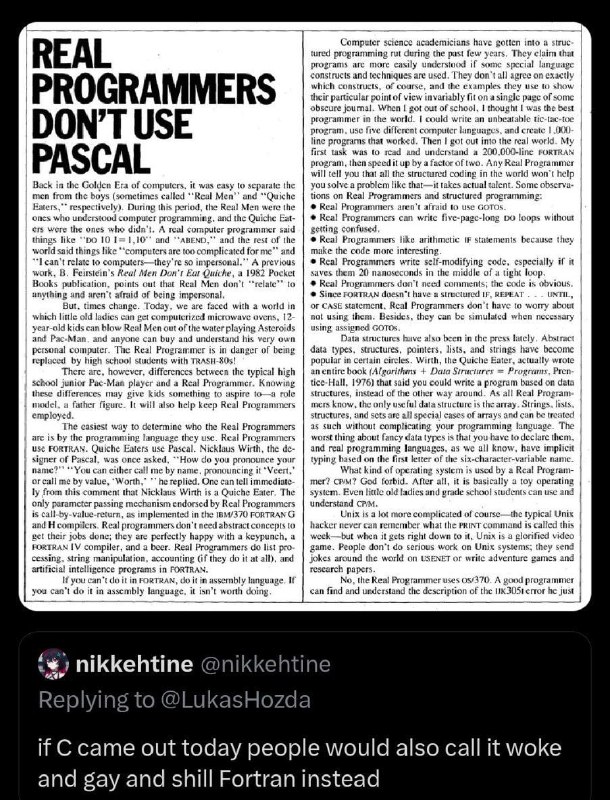
A screenshot pairs a satirical “Real Programmers Don’t Use Pascal” article praising Fortran with a reply saying that if C had been created today, people would call it “woke and gay” and shill Fortran instead. The joke applies the article’s old-fashioned programming-language tribalism to modern culture-war language, treating C as if it were a controversial new ideology. It is used as an ironic reaction to debates about programming languages, tech hype, or retro programmer gatekeeping. EN: A screenshot pairs a satirical “Real Programmers Don’t Use Pascal” article praising Fortran with a reply saying that if C had been created today, people would call it “woke and gay” and shill Fortran instead. The joke applies the article’s old-fashioned programming-language tribalism to modern culture-war language, treating C as if it were a controversial new ideology. It is used as an ironic reaction to debates about programming languages, tech hype, or retro programmer gatekeeping.
- @ithueti / 16429 2025-07-21
- Type
- image
- Size
- 610×800 · 179.7 KiB
- Mood
- satirical, absurd
- Language
- en
- Added