Among Us Bayes' Theorem
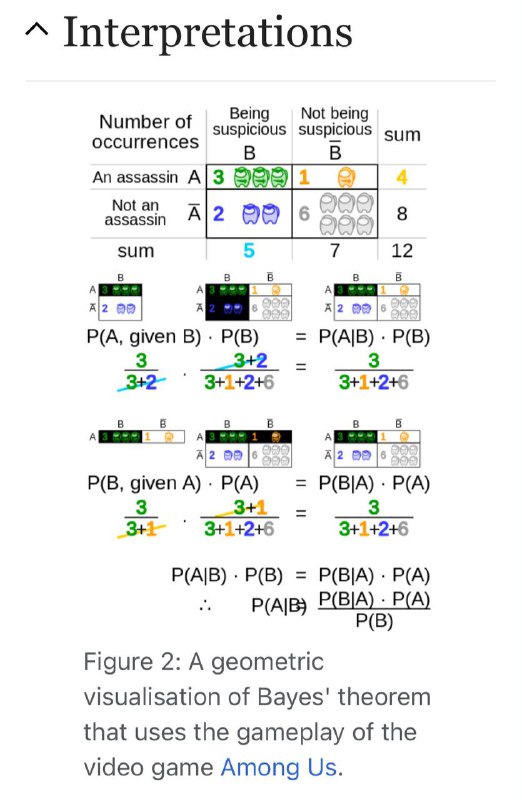
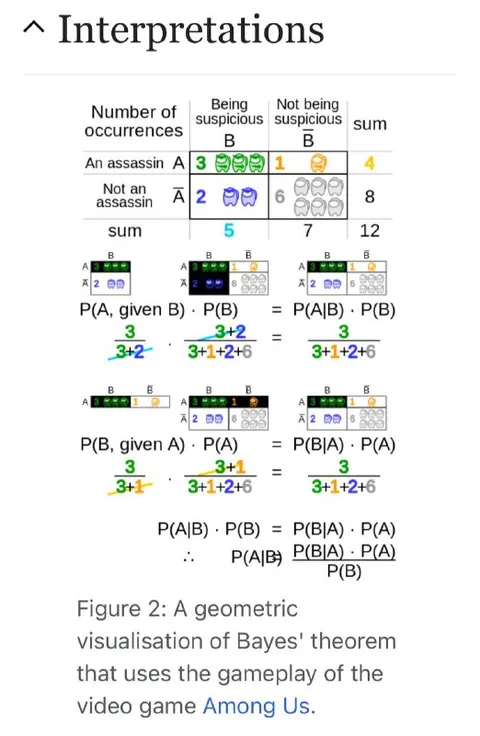
^ Interpretations Number of occurrences Being suspicious B Not being suspicious B̄ sum An assassin A 3 1 4 Not an assassin Ā 2 6 8 sum 5 7 12 P(A, given B) · P(B) = P(A|B) · P(B) 3/(3+2) · (3+2)/(3+1+2+6) = (3)/(3+1+2+6) · (3+1+2+6)/(3+1+2+6) P(B, given A) · P(A) = P(B|A) · P(A) 3/(3+1) · (3+1)/(3+1+2+6) = (3)/(3+1+2+6) · (3+1+2+6)/(3+1+2+6) P(A|B) · P(B) = P(B|A) · P(A) ∴ P(A|B) = P(B|A) · P(A)/P(B) Figure 2: A geometric visualisation of Bayes' theorem that uses the gameplay of the video game Among Us.
The image presents Bayes’ theorem using a table of assassins and suspicious players from Among Us, with colored crewmate icons and probability calculations. The joke is the absurdly academic treatment of identifying an assassin as a formal probability exercise, making the game’s simple deduction mechanics look like advanced mathematics.
mathematical table / математическая таблицаprobability formula / формула вероятностиcolored crewmate icons / цветные значки членов экипажаgreen crewmates / зелёные члены экипажаorange crewmate / оранжевый член экипажаpurple crewmates / фиолетовые члены экипажаgray crewmates / серые члены экипажаtextbook-style diagram / схема в стиле учебникаequations / уравненияAmong Us game reference / отсылка к игре Among Us
- @ithueti / 9647 2023-06-22
- Type
- image
- Size
- 522×800 · 66.7 KiB
- Mood
- absurd, academic
- Language
- en
- Added