Alchemy Becomes Modern Chemistry
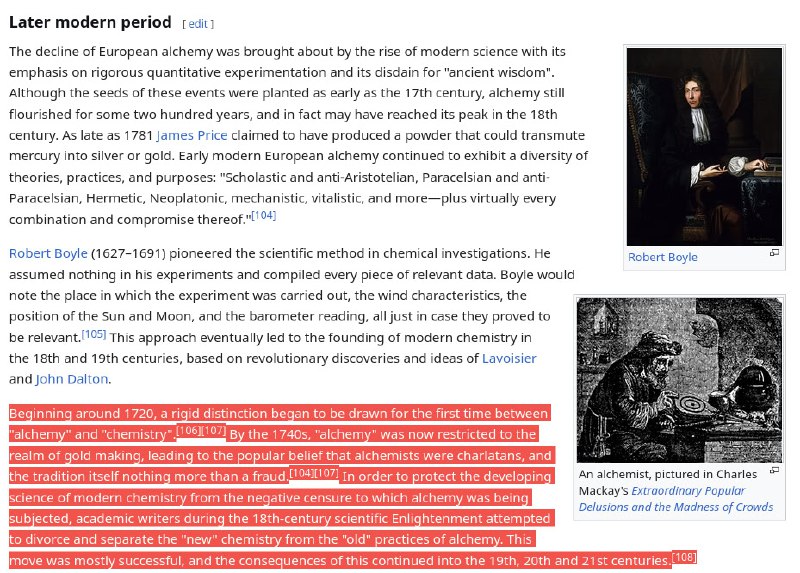
Later modern period [edit] The decline of European alchemy was brought about by the rise of modern science with its emphasis on rigorous quantitative experimentation and its disdain for "ancient wisdom". Although the seeds of these ideas were planted as early as the 17th century, alchemy still flourished for some two hundred years, and in fact may have reached its peak in the 18th century. As late as 1781 James Price claimed to have produced a powder that could transmute mercury into silver or gold. Early modern European alchemy continued to exhibit a diversity of theories, practices, and purposes: "Scholastic and anti-Aristotelian, Paracelsian and anti-Paracelsian, Hermetic, Neoplatonic, mechanistic, vitalistic, and more—plus virtually every combination and compromise thereof." Robert Boyle (1627–1691) pioneered the scientific method in chemical investigations. He assumed nothing in his experiments and compiled every piece of relevant data. Boyle would note the place in which the experiment was carried out, the wind characteristics, the position of the Sun and Moon, and the barometer reading, all just in case they proved to be relevant. This approach eventually led to the founding of modern chemistry in the 18th and 19th centuries, based on revolutionary discoveries and ideas of Lavoisier and John Dalton. Beginning around 1720, a rigid distinction began to be drawn for the first time between "alchemy" and "chemistry". By the 1740s, "alchemy" was now restricted to the realm of gold making, leading to the popular belief that alchemists were charlatans, and the tradition itself nothing more than a fraud. In order to protect the developing science of modern chemistry from the negative censure to which alchemy was being subjected, academic writers during the 18th-century scientific Enlightenment attempted to divorce and separate the "new" chemistry from the "old" practices of alchemy. This move was mostly successful, and the consequences of this continued into the 19th, 20th and 21st centuries. Robert Boyle An alchemist, pictured in Charles Mackay's Extraordinary Popular Delusions and the Madness of Crowds
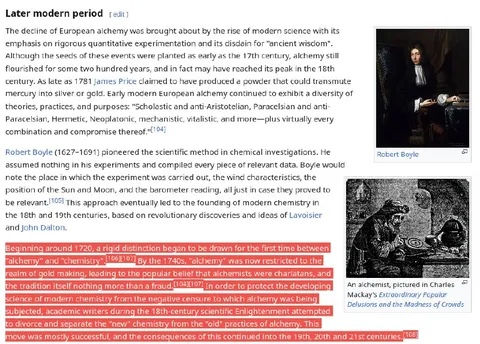
A Wikipedia screenshot about the transition from European alchemy to modern chemistry, with a paragraph highlighted in red explaining how alchemy became associated with gold-making, charlatans, and fraud. It is used humorously as an overdramatic reaction to someone distinguishing mystical alchemy from scientific chemistry.
Wikipedia article / статья Википедииhighlighted paragraph / выделенный абзацportrait of Robert Boyle / портрет Роберта БойляRobert Boyle nameplate / подпись «Robert Boyle»engraving of an alchemist / гравюра алхимикаlaboratory table / лабораторный столglass vessel / стеклянный сосудbook page / страница книгиblack clothing / чёрная одеждаred text highlight / красная подсветка текста
- @antichirst / 19585 2025-05-15
- Type
- image
- Size
- 800×573 · 157.0 KiB
- Mood
- ironic, absurd
- Language
- en
- Added