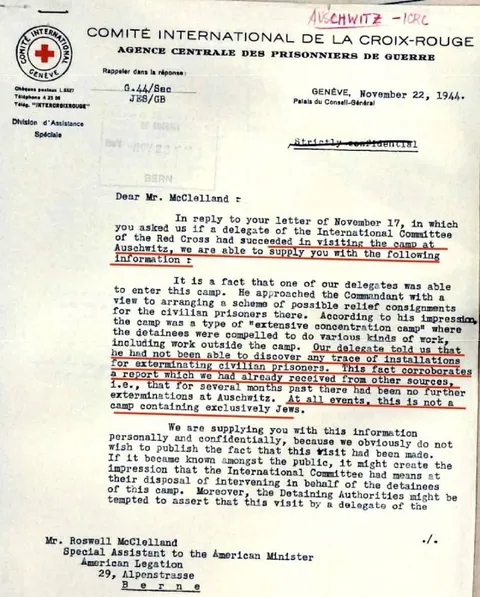
Red Cross Auschwitz Letter
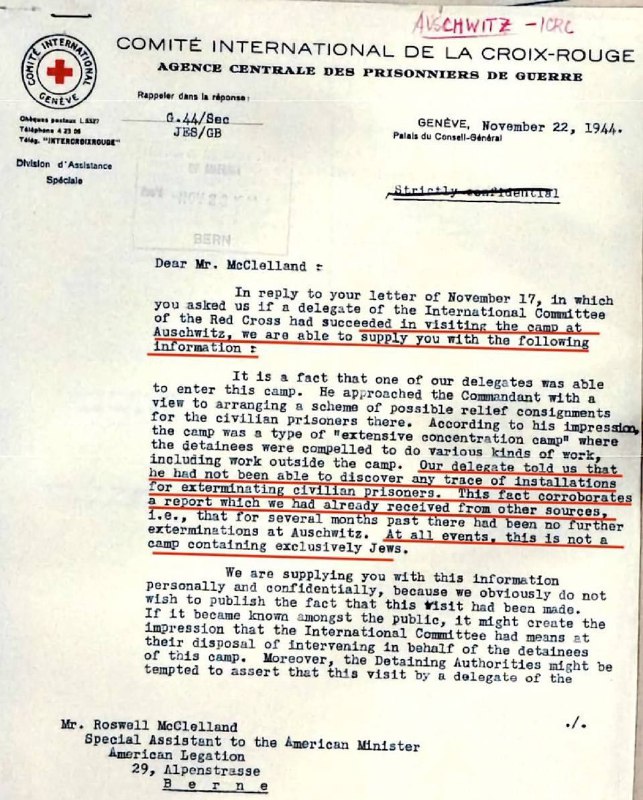
AUSCHWITZ - ICRC COMITE INTERNATIONAL DE LA CROIX-ROUGE AGENCE CENTRALE DES PRISONNIERS DE GUERRE Rapports dans la réponse: G. 44/Sec JES/GB GENÈVE, November 22, 1944. Palais du Conseil-Général Strictly confidential Dear Mr. McClelland: In reply to your letter of November 17, in which you asked us if a delegate of the International Committee of the Red Cross had succeeded in visiting the camp at Auschwitz, we are able to supply you with the following information: It is a fact that one of our delegates was able to enter this camp. He approached the Commandant with a view to arranging a scheme of possible relief consignments for the civilian prisoners there. According to his impression, the camp was a type of "extensive concentration camp" where the detainees were compelled to do various kinds of work, including work outside the camp. Our delegate told us that he had not been able to discover any trace of installations for exterminating civilian prisoners. This fact corroborates a report which we had received from other sources, i.e., that for several months past there had been no further exterminations at Auschwitz. At all events, this is not a camp containing exclusively Jews. We are supplying you with this information personally and confidentially, because we obviously do not wish to publish the fact that this visit had been made. If it became known amongst the public, it might create the impression that the International Committee had neglected their disposal of intervening in behalf of the detainees of this camp. Moreover, the Detaining Authorities are tempted to assert that this visit by a delegate of the Mr. Roswell McClelland Special Assistant to the American Minister American Legation 29, Alpenstrasse B e r n e
A historical 1944 letter from the International Committee of the Red Cross discusses a delegate’s visit to Auschwitz and claims that no extermination installations for civilian prisoners were found, while minimizing the camp’s function. The image is used as a dark historical reference or reaction to denial, bureaucratic euphemism, and institutional complicity. EN: A historical 1944 letter from the International Committee of the Red Cross discusses a delegate’s visit to Auschwitz and claims that no extermination installations for civilian prisoners were found, while minimizing the camp’s function. The image is used as a dark historical reference or reaction to denial, bureaucratic euphemism, and institutional complicity.
historical letter / историческое письмоtypewritten document / машинописный документRed Cross emblem / эмблема Красного Крестаofficial letterhead / официальный бланкred underlining / красное подчёркиваниеstamped markings / штампованные отметкиpaper sheet / лист бумагиblack ink / чёрные чернилаhandwritten annotation / рукописная пометкаdate / датаsignature area / место для подписиarchival document / архивный документ
- @antichirst / 18278 2024-11-16
- Type
- image
- Size
- 643×800 · 145.2 KiB
- Mood
- dark, disturbing
- Language
- en
- Added