The Exponential Time Hypothesis Is False
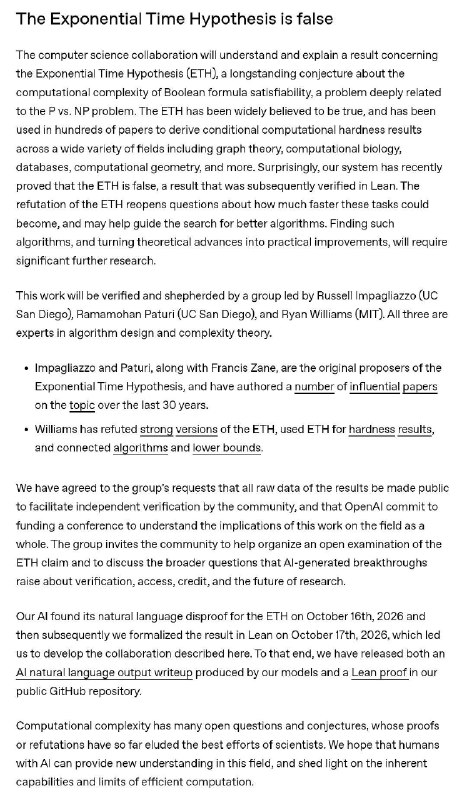
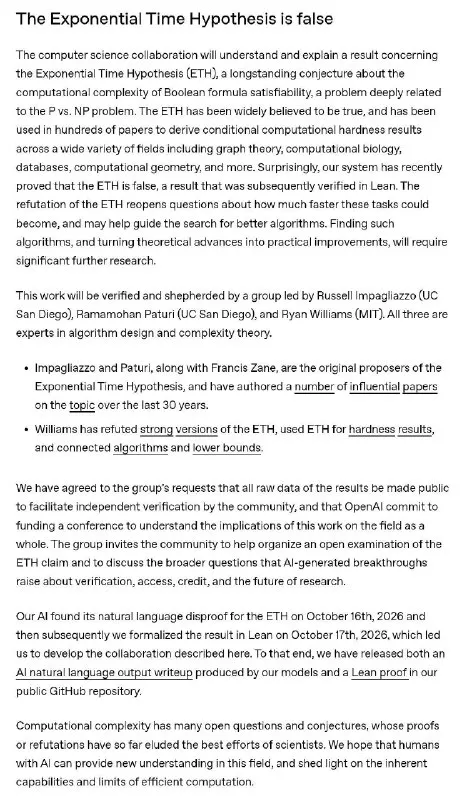
The Exponential Time Hypothesis is false The computer science collaboration will understand and explain a result concerning the Exponential Time Hypothesis (ETH), a longstanding conjecture about the computational complexity of Boolean formula satisfiability problem deeply related to the P vs. NP problem. The ETH has been widely believed to be true, and has been used in hundreds of papers to derive conditional computational hardness results across a wide variety of fields including graph theory, computational biology, databases, computational geometry, and more. Surprisingly, our system has recently proved that the ETH is false, a result that was subsequently verified in Lean. The refutation of the ETH reopens questions about how much faster these tasks could become, and may guide the search for better algorithms. Finding such algorithms, and turning theoretical advances into practical improvements, will require significant further research. This work will be verified and shepherded by a group led by Russell Impagliazzo (UC San Diego), Ramamohan Paturi (UC San Diego), and Ryan Williams (MIT). All three are experts in algorithm design and complexity theory. • Impagliazzo and Paturi, along with Francis Zane, are the original proposers of the Exponential Time Hypothesis, and have authored a number of influential papers on the topic over the last 30 years. • Williams has refuted strong versions of the ETH, used ETH for hardness results, and connected algorithms and lower bounds. We have agreed to the group’s requests that all raw data of the results be made public to facilitate independent verification by the community, and that OpenAI commit to funding a conference to understand the implications of this work on the field as a whole. The group invites the community to help organize an open examination of the ETH claim and to discuss the broader questions that AI-generated breakthroughs raise about verification, access, credit, and the future of research. Our AI found its natural language disproof for the ETH on October 16th, 2026 and then subsequently we formalized the result in Lean on October 17th, 2026, which led us to develop the collaboration described here. To that end, we have released both an AI natural language output writeup produced by our models and a Lean proof in our public GitHub repository. Computational complexity has many open questions and conjectures, whose proofs or refutations so far eluded the best efforts of scientists. We hope that humans with AI can provide new understanding in this field, and shed light on the inherent capabilities and limits of efficient computation.
A mock research announcement claims that an AI collaboration has disproved the Exponential Time Hypothesis and formally verified the result in Lean. The joke comes from presenting an absurdly monumental theoretical-computer-science breakthrough in the polished language of an official OpenAI-style statement, while the uploader’s caption bluntly declares that ETH is false. It is used as a reaction to spectacular, implausible AI claims or supposedly world-changing mathematical breakthroughs.
research paper / научная статьяcomputer science text / текст по информатикеtitle heading / заголовокparagraphs / абзацыbullet points / маркированные пунктыhyperlinks / гиперссылкиwhite page / белая страницаblack text / чёрный текстAI research announcement / объявление об исследовании ИИLean proof / доказательство в LeanGitHub repository / репозиторий GitHubBoolean formula / булева формулаmathematical notation / математическая записьunderlined text / подчёркнутый текст
#экспоненциальная временная гипотеза#exponential time hypothesis#теория сложности#complexity theory#теоретическая информатика#theoretical computer science#искусственный интеллект#artificial intelligence#математика#mathematics#доказательство#proof#lean#openai#абсурд#absurd#сарказм#sarcasm#реакция#reaction#научный мем#science meme#пародия#parody#ии-прорыв#ai breakthrough
- @gentoomemes / 22385 2026-10-26
- Type
- image
- Size
- 467×800 · 122.1 KiB
- Mood
- sarcastic, absurd
- Language
- en
- Added