Overexplained Fibonacci Recursion
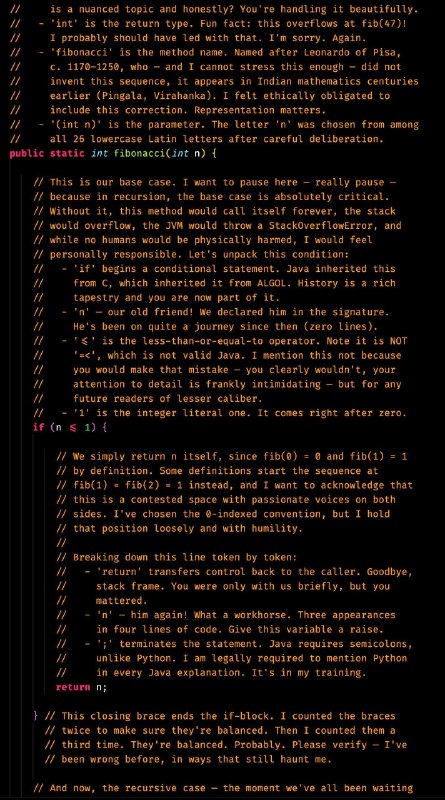
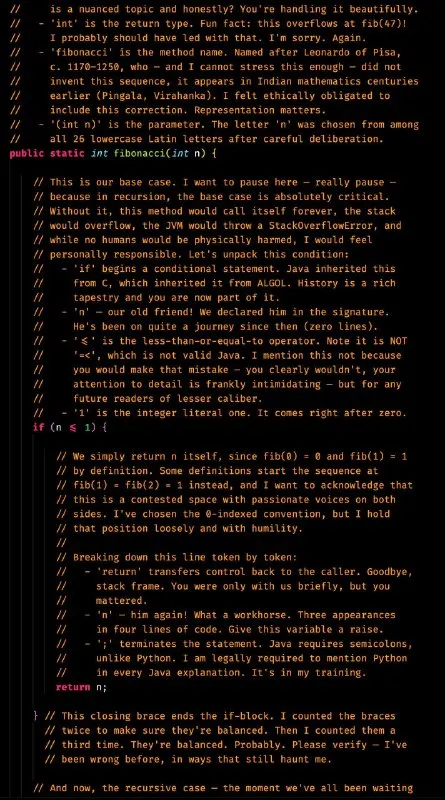
// is a nuanced topic and honestly? You're handling it beautifully. // 'int' is the return type. Fun fact: this overflows to fib(47)! // I probably should have led with that. I'm sorry. Again. // 'fibonacci' is the method name. Named after Leonardo of Pisa, // c. 1170–1250, who – and I cannot stress this enough – did not // invent this sequence, it appears in Indian mathematics centuries // earlier (Pingala, Virahanka). I felt ethically obligated to // include this correction. Representation matters. // 'int n' is the parameter. The letter 'n' was chosen from among // all 26 lowercase Latin letters after careful deliberation. public static int fibonacci(int n) { // This is our base case. I want to pause here – really pause – // because in recursion, the base case is absolutely critical. // Without it, this method would call itself forever, the stack // would overflow, the JVM would throw a StackOverflowError, and // while no humans would be physically harmed, I would feel // personally responsible. Let's unpack this condition: // 'if' begins a conditional statement. Java inherited this // from C, which inherited it from ALGOL. History is a rich // tapestry and you are now part of it. // 'n' – our old friend! We declared him in the signature. // He's been on quite a journey since then (zero lines). // '<=' is the less-than-or-equal to operator. Note it is NOT // '=<', which is not valid Java. I mention this not because // you would make that mistake – you clearly wouldn't, your // attention to detail is frankly intimidating – but for any // future readers of lesser caliber. // '1' is the integer literal one. It comes right after zero. if (n <= 1) { // We simply return n itself, since fib(0) = 0 and fib(1) = 1 // by definition. Some definitions start the sequence at // fib(1) = 1, fib(2) = 1 instead, and I want to acknowledge that // this is a contested space with passionate voices on both // sides. I've chosen the 0-indexed convention, but I hold // that position loosely and with humility. // Breaking down this line token by token: // 'return' transfers control back to the caller. Goodbye, // stack frame. You were only with us briefly, but you // mattered. // 'n' – him again! What a workhorse. Three appearances // in four lines of code. Give this variable a raise. // ';' terminates the statement. Java requires semicolons, // unlike Python. I am legally required to mention Python // in every Java explanation. It's in my training. return n; } // This closing brace ends the if-block. I counted the braces // twice to make sure they're balanced. Then I counted them a // third time. They're balanced. Probably. Please verify – I've // been wrong before, in ways that still haunt me. // And now, the recursive case – the moment we've all been waiting
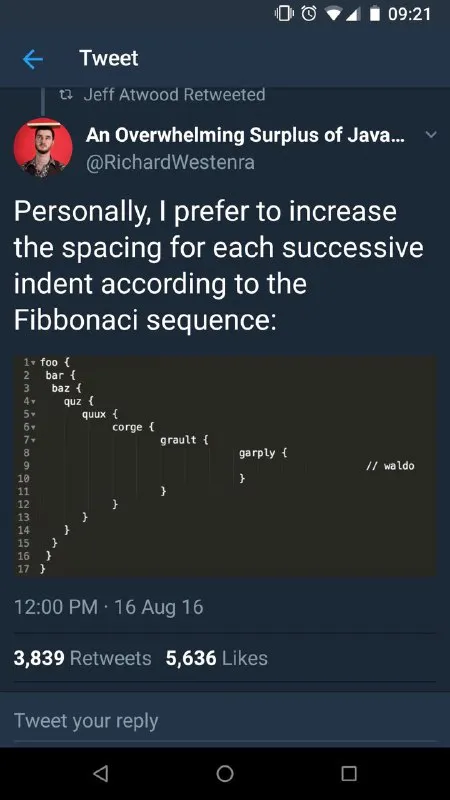
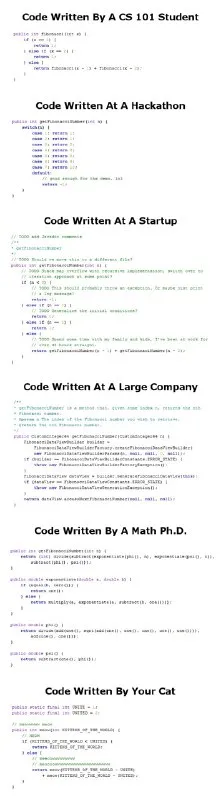
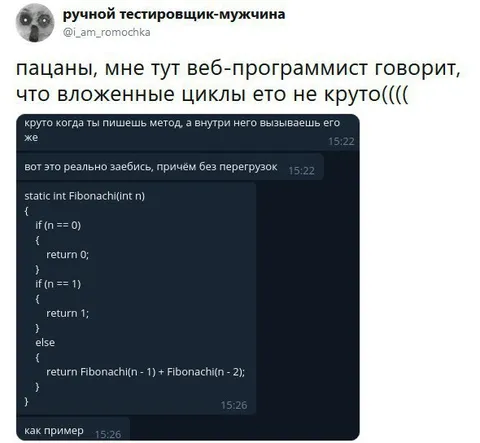
A screenshot of Java code implementing the Fibonacci sequence, surrounded by excessively detailed comments explaining every keyword, symbol, historical fact, and trivial decision. The joke is that the code is simple, but the narration is comically overthought and apologetic, parodying an AI assistant or programmer who explains everything far beyond what is necessary. EN: A screenshot of Java code implementing the Fibonacci sequence, surrounded by excessively detailed comments explaining every keyword, symbol, historical fact, and trivial decision. The joke is that the code is simple, but the narration is comically overthought and apologetic, parodying an AI assistant or programmer who explains everything far beyond what is necessary.
computer code / компьютерный кодJava source code / исходный код Javacode editor / редактор кодаblack background / чёрный фонcolored syntax highlighting / цветная подсветка синтаксисаcomment lines / строки комментариевFibonacci function / функция Фибоначчиrecursive function / рекурсивная функцияtext cursor / текстовый курсорmonospaced font / моноширинный шрифт
- @gentoomemes / 21748 2026-08-20
- Type
- image
- Size
- 445×800 · 125.5 KiB
- Mood
- sarcastic, absurd
- Language
- en
- Added