Ancient Greek Word Arete Means Based
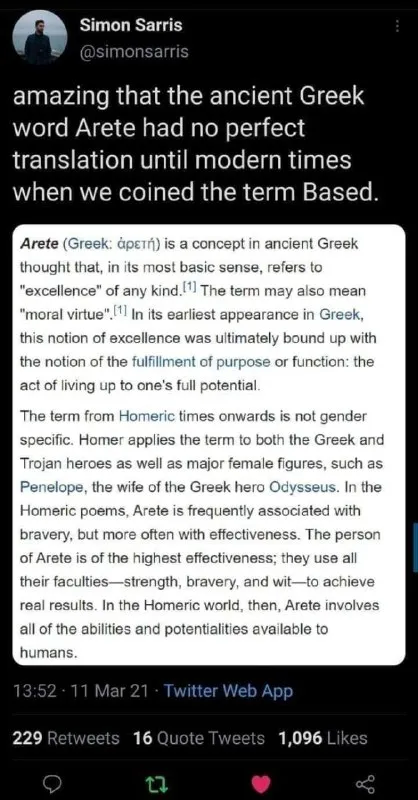
amazing that the ancient Greek word Arete had no perfect translation until modern times when we coined the term Based. Arete (Greek: ἀρετή) is a concept in ancient Greek thought that, in its most basic sense, refers to "excellence" of any kind.[1] The term may also mean "moral virtue".[1] In its earliest appearance in Greek, this notion of excellence was ultimately bound up with the notion of the fulfillment of purpose or function: the act of living up to one's full potential. The term from Homeric times onwards is not gender specific. Homer applies the term to both the Greek and Trojan heroes as well as major female figures, such as Penelope, the wife of the Greek hero Odysseus. In the Homeric poems, Arete is frequently associated with bravery, but more often with effectiveness. The person of Arete is of the highest effectiveness; they use all of their faculties—strength, bravery, and wit—to achieve real results. In the Homeric world, then, Arete involves all of the abilities and potentialities available to humans.
A Twitter screenshot shows a post explaining that the ancient Greek word “Arete,” meaning excellence or virtue and living up to one’s full potential, lacked a perfect modern translation until the slang term “Based” was coined. The joke humorously presents modern internet slang as the long-awaited translation of a lofty classical concept, making it a reaction to someone being admirably confident or effective.
Twitter post / пост в Twittersmartphone screen / экран смартфонаsocial media interface / интерфейс социальной сетиprofile avatar / аватар профиляtext block / текстовый блокwhite rounded information card / белая информационная карточкаblack background / чёрный фонGreek writing / греческое написаниеtimestamp / отметка времени
- @eternalclassic / 49318 2024-04-12
- Template
- Twitter screenshot
- Type
- image
- Size
- 472×800 · 100.8 KiB
- Mood
- ironic, intellectual
- Language
- en
- Added