Electron Hole Wikipedia Explanation
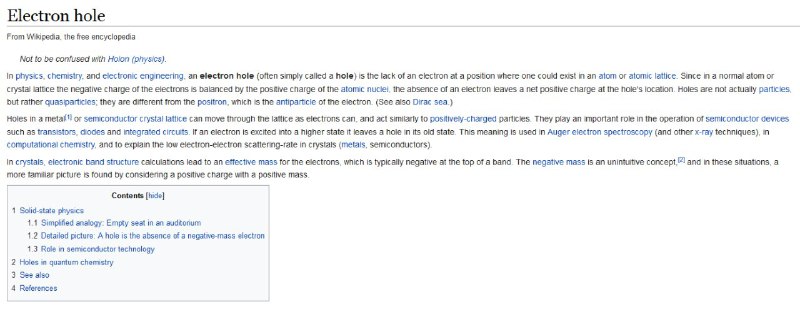
Electron hole From Wikipedia, the free encyclopedia Not to be confused with Holon (physics). In physics, chemistry, and electronic engineering, an electron hole (often simply called a hole) is the lack of an electron at a position where one could exist in an atom or atomic lattice. Since in a normal atom or crystal lattice the negative charge of the electrons is balanced by the positive charge of the atomic nucleus, the absence of an electron leaves a net positive charge at the hole's location. Holes are not actually particles, but rather quasiparticles; they are different from the positron, which is the antiparticle of the electron. (See also Dirac sea.) Holes in a metal (or semiconductor crystal lattice) can move through the lattice as electrons can, and act similarly to positively-charged particles. They play an important role in the operation of semiconductor devices such as transistors, diodes and integrated circuits. If an electron is excited into a higher state it leaves a hole in its old state. This meaning is used in Auger electron spectroscopy (and other x-ray techniques), in computational chemistry, and to explain the colour of semiconductor-containing crystals (metals, semiconductors). In crystals, electronic band structure calculations lead to an effective mass for the electrons, which is typically negative at the top of a band. The negative mass is an unintuitive concept, and in these situations, a more familiar picture is found by considering a positive charge with a positive mass. Contents [hide] 1 Solid-state physics 1.1 Simple analogy: Empty seat in an auditorium 1.2 Detailed picture: A hole is the absence of a negative-mass electron 1.3 Role in semiconductor device 2 Holes in quantum chemistry 3 See also 4 References
This image is a screenshot of a Wikipedia article titled “Electron hole,” explaining the physics concept of a missing electron behaving like a positively charged quasiparticle. The joke is that the uploader says, “Today I learned a new swear word,” while the technical term “electron hole” sounds like an English insult or profanity to a Russian-speaking viewer unfamiliar with the concept. EN: This image is a screenshot of a Wikipedia article titled “Electron hole,” explaining the physics concept of a missing electron behaving like a positively charged quasiparticle. The joke is that the uploader says, “Today I learned a new swear word,” while the technical term “electron hole” sounds like an English insult or profanity to a Russian-speaking viewer unfamiliar with the concept.
- @dustinthehead / 1203 2020-05-01
- Type
- image
- Size
- 800×314 · 48.3 KiB
- Mood
- absurd, witty
- Language
- en
- Added