Divine Benevolence in Machine Learning
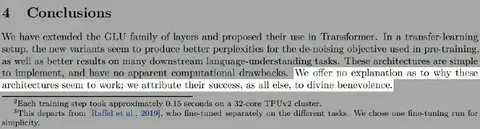
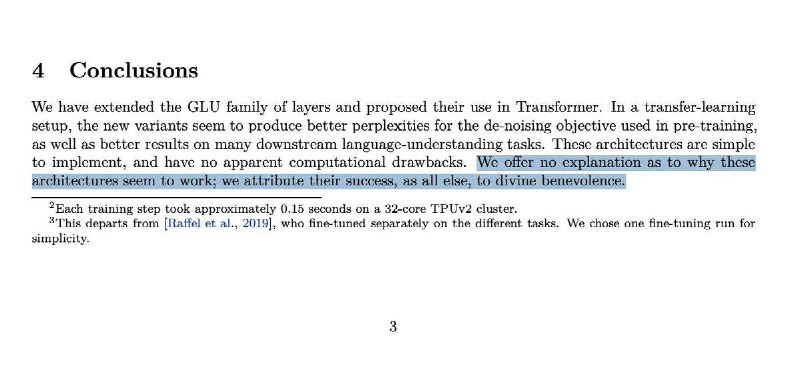
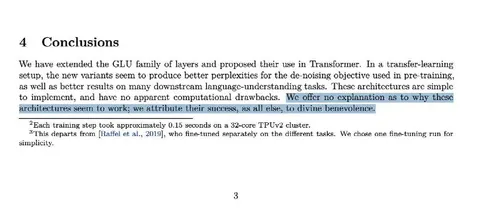
4 Conclusions We have extended the GLU family of layers and proposed their use in Transformer. In a transfer-learning setup, the new variants seem to produce better perplexities for the de-noising objective used in pre-training, as well as better results on many downstream language-understanding tasks. These architectures are simple to implement, and have no apparent computational drawbacks. We offer no explanation as to why these architectures seem to work; we attribute their success, as all else, to divine benevolence. ²Each training step took approximately 0.15 seconds on a 32-core TPUv2 cluster. ³This departs from [Raffel et al., 2019], who fine-tuned separately on the different tasks. We chose one fine-tuning run for simplicity.
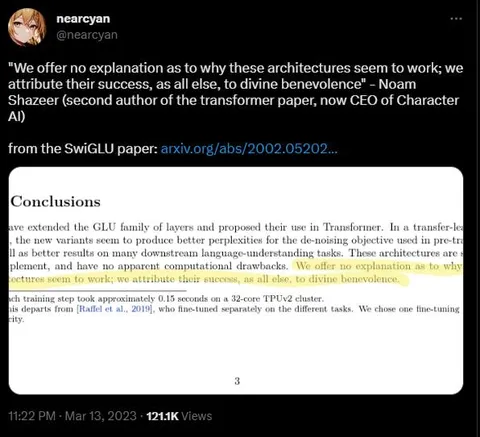
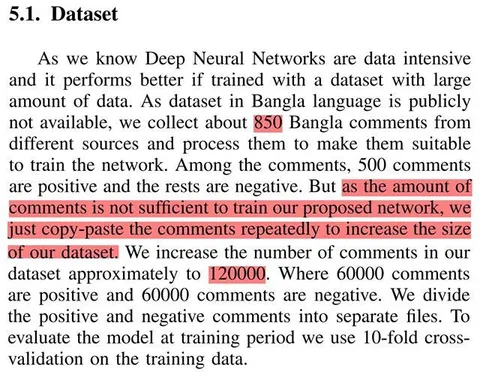
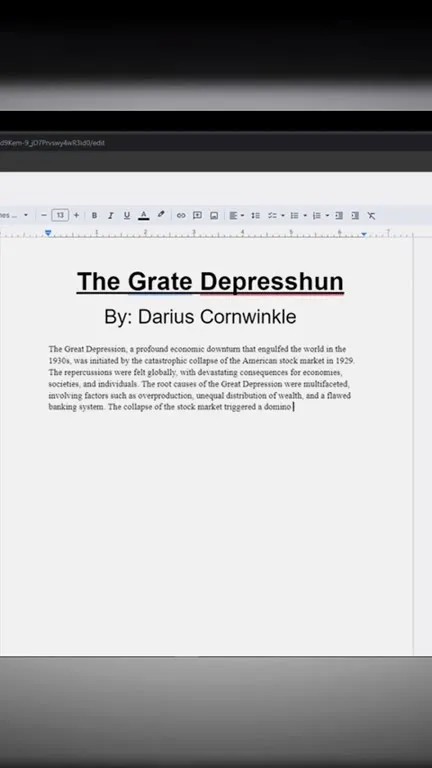
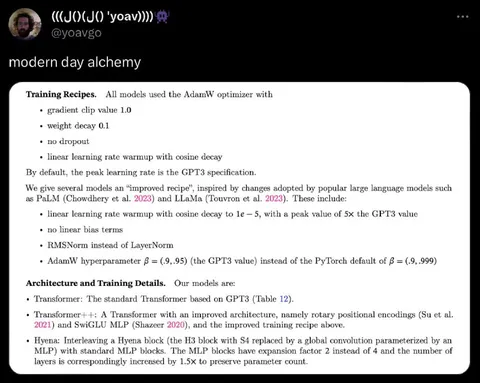
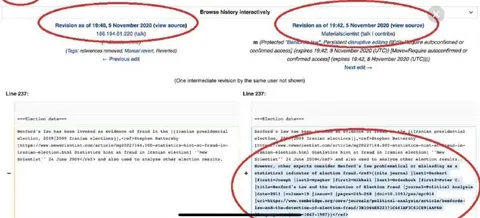
A screenshot of an academic paper’s conclusions section, with the line about attributing the model’s success to “divine benevolence” highlighted. The joke is the mock-religious explanation offered instead of a technical account, making it a reaction to unexpectedly impressive or inexplicable results in machine learning.
- @dev_meme / 7015 2025-08-08
- @gentoomemes / 18647 2025-09-18
- Type
- image
- Size
- 800×372 · 52.9 KiB
- Mood
- sarcastic, absurd
- Language
- en
- Added