Divine Benevolence Explains Everything
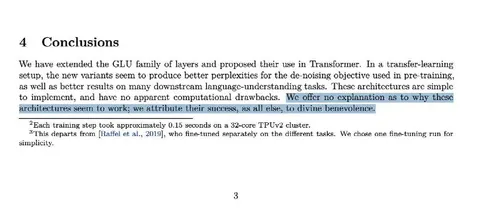
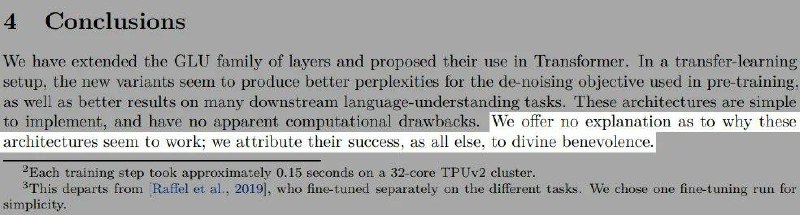
4 Conclusions We have extended the GLU family of layers and proposed their use in Transformer. In a transfer-learning setup, the new variants seem to produce better perplexities for the de-noising objective used in pre-training, as well as better results on many downstream language-understanding tasks. These architectures are simple to implement, and have no apparent computational drawbacks. We offer no explanation as to why these architectures seem to work; we attribute their success, as all else, to divine benevolence. 2 Each training step took approximately 0.15 seconds on a 32-core TPUv2 cluster. 3 This departs from [BaEfel et al., 2019], who fine-tuned separately on the different tasks. We chose one fine-tuning run for simplicity.
A screenshot of an academic paper’s “Conclusions” section discusses improved neural-network architectures and then openly admits that the authors cannot explain why they work, attributing the success to “divine benevolence.” The highlighted sentence is used as a sarcastic reaction to unexplained success, hand-waving, or results that seem too good to justify. objects
academic paper / научная статьяconclusion heading / заголовок выводаparagraph text / текст абзацаhighlighted sentence / выделенное предложениеfootnotes / сноскиcomputer typography / компьютерная типографикаgray background / серый фонresearch citation / ссылка на исследованиеneural-network architecture / архитектура нейросетиTransformer model / модель TransformerTPUv2 cluster / кластер TPUv2mathematical notation / математическое обозначение
#academic paper#научная статья#divine benevolence#божественное провидение#machine learning#машинное обучение#ai#ии#research#исследование#sarcasm#сарказм#unexplained success#необъяснимый успех#conclusion#вывод#highlight#выделение#reaction#реакция#screenshot#скриншот#programming#программирование#нейросеть#neural network
- @gentoomemes / 16404 2025-03-13
- Type
- image
- Size
- 800×215 · 54.8 KiB
- Mood
- sarcastic, absurd
- Language
- en
- Added